Over One Million People in Britain Quit Smoking Last Year. The Health Benefits Start Faster Than You Think
When I talk to patients about quitting smoking, the most common thing I hear is this: "I've tried before, and it didn't work." I understand that feeling. But new research from the UK offers a more encouraging story, and it's one worth sharing with anyone who's ever wanted to stop but hasn't quite got there yet.

More than one million people in England stopped smoking in the past year. These are ordinary people with busy lives, real stress, and habits built over years. They managed to quit, and every one of them is now benefiting from it.
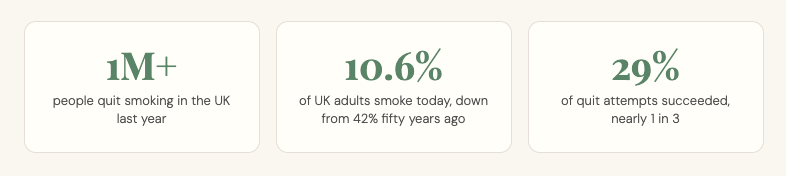
These figures come from the Smoking Toolkit Study, a long-running national survey run by University College London that has tracked smoking behaviour in England since 2006. Researchers found that around a third of the UK's estimated 10 million smokers made a quit attempt in the past year, and of those who tried, roughly 29 percent succeeded. That's not a small number. That's a real public health shift.
Why Quitting Matters More Than Almost Anything Else
As a GP, I'm often asked what the single best thing someone can do for their health is. The answer, for a smoker, is always the same. It isn't a new supplement, a better diet, or a different exercise routine. It's stopping smoking.
Smoking is the UK's leading preventable cause of cancer, linked to at least 16 different types. It also significantly raises the risk of heart disease, stroke, lung disease, and dementia, and is estimated to contribute to more than one in ten deaths in the country every year.
"Stopping smoking completely is the best thing you can do for your health."
— Ian Walker, Policy Director, Cancer Research UK
There's a sobering statistic I often share with patients: government research suggests each cigarette smoked may shorten life by around 20 minutes on average. A pack-a-day habit, sustained over years, adds up to something significant. What I find remarkable is how quickly the body starts to turn things around once you stop.
What Happens to Your Body When You Stop
One of the most useful things I can do in these conversations is walk people through what actually happens after that last cigarette. The recovery timeline surprises most people, because it begins far sooner than they expect.
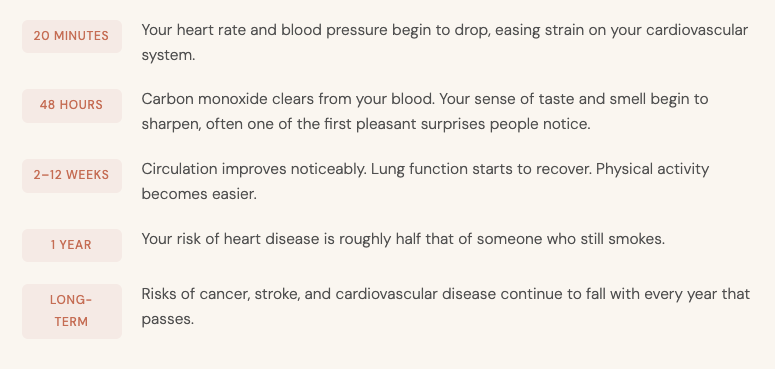
The body is remarkably resilient. Given the opportunity, it heals. Stopping smoking is the single most effective thing you can do to give yourself that chance.
What Actually Helps People Quit
Many people try to stop on their own, and some do succeed. But research consistently shows that using support, whether medical or behavioural, meaningfully increases your chances. Data from the Smoking Toolkit Study found that e-cigarettes were the most commonly used quitting aid in England, featuring in around 40 percent of quit attempts.
That said, it's worth being clear: vaping is a quitting tool, not a long-term goal. While e-cigarettes are considerably less harmful than smoking, they are not risk-free, and the aim should always be to stop nicotine altogether eventually. If you've switched from cigarettes to a vape and feel stuck there, it's worth having a conversation with your GP about a plan to step down.
Other well-evidenced options include nicotine replacement therapy such as patches, gum, or lozenges; prescription medications like varenicline; and structured support from NHS stop-smoking services. These services are free, available to everyone, and they work.
The key message is that you don't have to do this alone, and using support isn't a sign of weakness. It's a sign of taking the whole thing seriously.
On "Failed" Attempts
If you've tried before and not managed to stay stopped, please don't read that as evidence that you can't do it. Most people make several attempts before quitting for good. That's not failure. It's simply how lasting behaviour change tends to work.
Each attempt builds knowledge. You learn what your triggers are, what support helps, what times of day are hardest. That knowledge isn't wasted. It's preparation.
Thinking About Stopping?
You can speak to your GP or pharmacist about what options are right for you. NHS stop-smoking services offer free, personalised support and significantly improve your chances of success.
You can also explore the Smoking Toolkit Study data and find further resources at smokinginengland.info, which gives a useful picture of what's actually helping people across the country.
The broader picture is encouraging. Smoking prevalence in England has fallen from around 18.8 percent in 2013 to roughly 11 percent today. Public health experts now believe a "smokefree generation", where fewer than 5 percent of adults smoke, is an achievable goal. Getting there will need continued support for people trying to quit, but with over a million people stopping last year, the direction of travel is clear.
The UK government is also taking steps to make sure the next generation never starts. The Tobacco and Vapes Bill, currently making its way through Parliament, will ban the sale of tobacco to anyone born on or after 1 January 2009. Because that age threshold rises by one year every year, anyone born from 2009 onwards will never legally be old enough to buy cigarettes in the UK. The aim is to phase out smoking among young people almost entirely by 2040. The bill also introduces tighter controls on vapes, including restrictions on flavours and packaging, and a ban on disposable vapes that came into force in June 2025.
If you're thinking about making a change, I hope this helps. Your body will start responding the moment you stop.